

By Amanda Tan, Ph.D., Associate Director, Research and AI Enablement, MS-CC
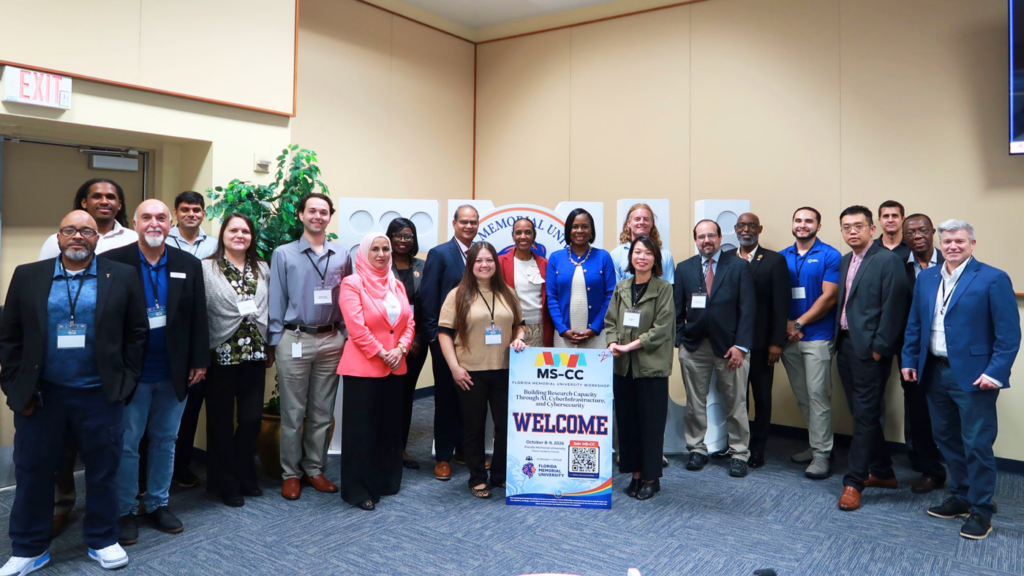
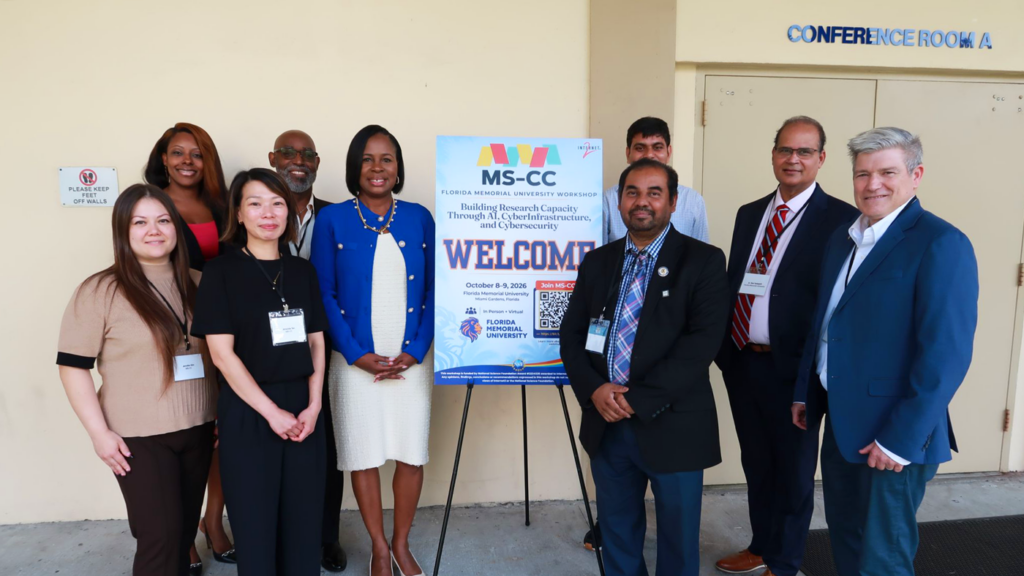
South Florida’s minority-serving institutions have research ambition. What many lack is the infrastructure, technical staff, and partnerships to compete for major funding. On October 8–9, 2026, the Minority Serving – Cyberinfrastructure Consortium (MS-CC) and Florida Memorial University (FMU) brought together 31 faculty, researchers, technology professionals, and regional partners from 7 institutions in Miami Gardens to work on that gap.
The two-day workshop, Building Research Capacity through AI, Cyberinfrastructure, and Cybersecurity, focused on what institutions can build together that none could build alone.
Day One: Using What the Region Already Has
The workshop opened with a panel moderated by Dr. Amanda Tan (MS-CC), featuring Dr. Jayanta Das (FMU), Dr. Ravi Vadapalli (University of Miami), and Jon Ellis (Florida LambdaRail). Panelists looked at how institutions can share regional research infrastructure and expertise instead of building them alone. Their most practical idea: form cross-institutional partnerships around shared research priorities, using the regional cyberinfrastructure that already exists, to compete more strongly for federal funding.
MS-CC’s Jennifer Kim then walked participants through national resources available to them now, including NAIRR and ACCESS. Using an NSF cyberinfrastructure solicitation as a case study, participants practiced turning institutional research needs into a competitive proposal.
Dr. Enas Albataineh (FMU) and Dr. Patrick Doliny (Enterprise Intelligence Institute) closed the day with a joint presentation on emerging cybersecurity approaches, including passwordless authentication, and on FMU’s Innovation Center. Their case: cybersecurity is part of an institution’s research strategy, not separate from it.
Day Two: AI, the Workforce, and the Classroom
How should institutions prepare students for a workforce shaped by AI? Randee Deich of South Florida TechGateway and the Greater Fort Lauderdale Alliance opened day two with the employer’s view: how AI is changing South Florida’s industries and the skills companies now hire for. The discussion pointed to a need for tighter links between K–12 schools, higher education, and industry.
Dr. Rajesh Pasupuleti of the University of Miami’s Frost Institute for Data Science and Computing (IDSC) explored the practical applications and limitations of AI, highlighting examples already being implemented across the university. These included AI-powered teaching assistants developed to support students in courses ranging from art history and biology to chemistry and data science. By helping answer student questions, these tools can reduce routine demands on faculty while providing students with additional learning support. Nick Alberti complemented the discussion with an overview of the university’s advanced computing infrastructure supporting AI-enabled research.
Dr. Vadapalli then led a working session on a practical problem: how to bring AI into existing curricula across disciplines. Using bioinformatics as the example, participants worked through an “AI for X” framework that pairs disciplinary expertise with AI skills and cyberinfrastructure resources, so faculty can teach AI within their own fields.
What Participants Told Us
All 14 survey respondents reported being satisfied or very satisfied with the workshop. Nine plan to integrate AI into teaching or curriculum, seven plan to apply AI tools in their research, and six intend to pursue collaborations with other institutions. Eleven want future workshops or a Community of Practice.
Respondents valued the networking. They also asked for more hands-on training and practical help putting these ideas to work.
“Learning about the available partnership opportunities and thought-provoking questions during the panels. I was also exposed to the available cyberinfrastructure and technical expertise of other institutions.”
~ Nick Alberti, Systems Administrator, IDSC, University of Miami
Looking Ahead
Access to technology alone doesn’t build research capacity. Institutions also need expertise, infrastructure, and partners. MS-CC looks forward to continuing its work with FMU, the University of Miami, and regional partners on faculty development, hands-on AI training, and collaborative funding opportunities.
Thank You
Thanks to Florida Memorial University for hosting; to Executive Vice President and Provost Dr. Jacqueline B. Hill, Dr. Jayanta Das, and Dr. Frederick Hunter for their support on campus; and to Alexia Jones, Yasmine House, and the MS-CC team for planning and coordination.
For questions about Research and AI Enablement on your campus, email Amanda Tan at atan@internet2.edu.