

By Alexia Jones, Senior Program Manager, and Amanda Tan, Associate Director, MS-CC
Students transformed 26 years of agricultural and environmental data into working prototypes during a 24-hour hackathon hosted by Delaware State University and MS-CC.
“I can now create Streamlit apps/websites and host them on the cloud. It’s a really useful feature to deploy dashboards without using AWS or an actual website. And I can also just pull the code for it from the repo.”
~ Jesús Lorenzo Ramírez Perales, Electrical Engineering Student, Delaware State University (Team Shark)
How can historical drought patterns help farmers anticipate crop losses? Can soil and climate data help agricultural agencies prioritize conservation resources? And how can artificial intelligence (AI) and computational tools make complex agricultural information more accessible to the people who need it?
These were among the questions explored by students at Delaware State University (DSU) during the Data to Harvest: AI for Agricultural Resilience Hackathon, held October 17–18, 2026.
DSU and the MS-CC collaborated to organize the 24-hour event, which challenged students to apply AI, data science, and research computing to real-world agricultural problems.
Eight student teams developed projects ranging from drought-risk assessment and crop-yield forecasting to agricultural insurance modeling, soil conservation planning, and interactive geospatial applications.
Rather than simply analyzing datasets, students were challenged to identify a specific user, define an agricultural decision, and build a functional tool that could communicate evidence to support that decision.
Congratulations to Team HARVEST!
Team HARVEST (Tyler Ervin, Christian King, Evans Armantrading III, Mustafa Akilli) earned first place in the Data to Harvest Hackathon, receiving the highest overall evaluation from the judging panel.
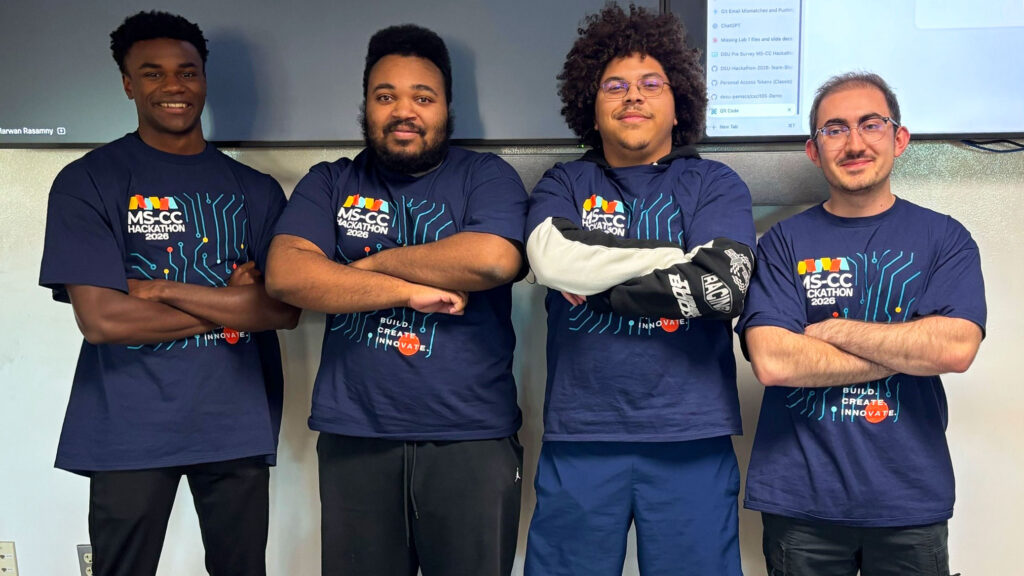
The team developed an interactive agricultural decision-support application that integrates historical climate, crop production, and geospatial information to explore agricultural risks.
Built using Python, Streamlit, Plotly, and machine learning tools, the application includes interactive geographic visualizations, historical drought analysis, agricultural insurance payout predictions, and scenario-based crop-loss planning.
Its insurance modeling component focuses on corn and soybeans in Iowa and Nebraska, while other features allow users to explore agricultural conditions across multiple states and crop types.
The judges recognized Team HARVEST for its strong technical implementation, effective integration of multiple agricultural and environmental datasets, and ability to translate complex information into an accessible tool for agricultural decision-making.
Explore Team HARVEST’s winning project
Seven More Teams, Seven Approaches to Agricultural Resilience
The remaining teams explored a wide range of agricultural challenges, demonstrating how computational methods can support different types of decisions.
Team JAMS: Agrigine
Team JAMS developed Agrigine, an interactive agricultural research and planning platform that brings together historical crop, weather, drought, soil, satellite, and insurance information.
The application provides geographic visualizations, county-level data exploration, and predictive modeling tools to help users examine agricultural conditions and potential risks. The team also documented historical validation exercises to evaluate its predictive methods against observed outcomes.
Team Irish-Spring-Green: CropShield
Team Irish-Spring-Green developed CropShield, an interactive dashboard designed to help agricultural extension specialists prioritize outreach related to heat stress and drought vulnerability.
The application combines temperature observations, drought severity, and soil-water-storage information to generate county-level advisory scores for corn and soybeans in Iowa. Users can explore geographic patterns and examine the environmental factors contributing to each score.
Explore Team Irish-Spring-Green’s project
Team Shark: Soil Program Planner
Team Shark developed a decision-support tool to help soil conservation agencies identify Iowa counties that may benefit from prioritized conservation outreach and resources.
Using historical crop yields, drought observations, and soil information, the team examined which counties experienced the greatest agricultural losses during drought conditions. The project also evaluated whether historical rankings could identify vulnerable counties in subsequent years, illustrating the importance of validating analytical approaches against independent observations.
Team Crop Buyer: ROOTED
Team Crop Buyer developed ROOTED, an application designed to help livestock producers and grain buyers evaluate alternative grain-sourcing locations.
Using historical county-level crop production records, the application allows users to compare their usual purchasing areas with potential backup locations. The team developed an approach for identifying counties with more consistent historical production and evaluating alternative sourcing strategies.
Explore Team Crop Buyer’s project
Team Wolverine: DroughtLens
Team Wolverine developed DroughtLens, an interactive application examining how similar drought classifications can produce different agricultural outcomes across regions.
Focusing on corn and soybeans in Iowa and Nebraska, the team analyzed historical relationships between drought severity and crop-yield losses. The application allows users to explore potential yield impacts based on location, crop type, and drought conditions, while comparing historical estimates against observations from subsequent years.
Explore Team Wolverine’s project
Team RootCause: FieldWise
Team RootCause developed FieldWise, an agricultural decision-support platform combining historical weather, drought, soil, and crop data.
The application includes tools for comparing county-level drought vulnerability, examining historical spring frost risks, and exploring evaporation-rate predictions. Its approach demonstrates how multiple environmental datasets can be integrated to support agricultural planning across different geographic regions.
Explore Team RootCause’s project
Team Geek Squad: Smart Drought Response
Team Geek Squad developed Smart Drought Response, a data-driven dashboard designed to help state agricultural agencies prioritize drought assistance for counties experiencing significant crop losses.
The team developed a county-ranking approach using historical drought and crop-yield data from 2000–2015, with an evaluation framework covering 2016–2025. Their application allows drought relief coordinators to explore county-level risk rankings, historical trends, and assistance thresholds, supporting more transparent, evidence-based decisions about allocating limited relief resources.
Explore Team Geek Squad’s project
Behind the Challenge: Building an Evidence-Based Learning Experience
The challenge was built around one principle: a useful computational tool must do more than produce an answer. It must help users understand the evidence behind that answer and recognize its limitations.
Each team was asked to identify a target user, define a specific agricultural decision, select appropriate evidence, and build a working prototype. Teams also had to account for the limits of their data and methods, including missing observations, geographic differences, and uncertainty in predictive models.
To support that work, students received 26 years of agricultural and environmental data, from 2000 to 2025, drawn from federal sources including USDA, NOAA, NASA, and the U.S. Drought Monitor. The datasets covered California, Delaware, Iowa, and Nebraska and included historical crop yields, daily weather observations, drought conditions, soil characteristics, and satellite observations.
Data to Harvest also marked a milestone for MS-CC. Earlier MS-CC hackathons at Fort Valley State University and West Virginia State University were delivered in partnership with ESIIL. This time, the full program was developed and delivered in-house. Amanda Tan, Pavan Nara, and Sanju Timsina led the technical development and implementation, and Alexia Jones led program planning and event logistics in partnership with Delaware State University, with on-site support from Sidney Davis.
What Students Learned
Beyond the projects themselves, the hackathon provided students with hands-on experience in programming, data analysis, collaborative software development, and AI-assisted tools.
In a post-event survey of 32 participants, 75% reported gaining a better understanding of how research computing and AI can support real-world problem-solving, while nearly half reported increased confidence in using technical computing tools.
Students highlighted new skills in Python, Jupyter notebooks, GitHub, predictive modeling, and application development.
Perhaps most encouragingly, 88% indicated that they intend to apply these skills within the next six months, with many expressing interest in additional training opportunities.
These findings highlight both the value of hands-on technical learning experiences and the importance of providing opportunities for students to continue developing their skills beyond a single event.
Collaboration and Continued Learning
The hackathon brought together DSU students, faculty, technical mentors, and MS-CC staff to support an intensive, collaborative learning experience.
We extend our appreciation to judges Dr. Zhaofeng Zhang and Tariq Hook, along with mentors Dr. Matthew Tanzy, Zubair Abdul, Riyazuddin Mohammed, Mohammed N. Ibrahim, Christopher Irving, Jared Bryant, and Michael Danquah-Tabbi, for contributing their time and expertise.
Special thanks also go to Dr. Marwan Rasamny, Ms. Rozena Hawkins, and the DSU staff for their collaboration and support.
While the hackathon concluded after 24 hours, the projects provide a foundation for further development and learning. Students are encouraged to continue exploring AI, data science, and research computing through MS-CC’s educational programs, workshops, and Student Community of Practice.
Explore the student projects: MS-CC GitHub Organization
For information about future opportunities, contact Alexia Jones, MS-CC Senior Program Manager, at ajones@internet2.edu.