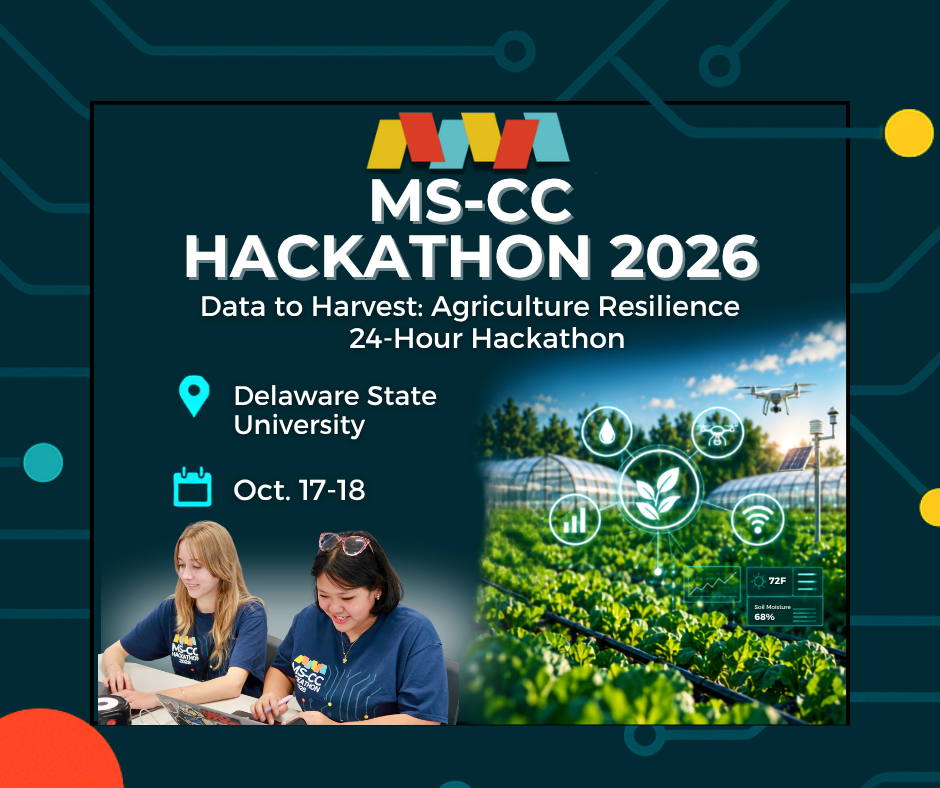
Data to Harvest: AI for Agricultural Resilience brings together up to 50 Delaware State University students to tackle real-world agricultural challenges using data, AI, and technology.
Working in teams of 3–5, students will use real-world agricultural and environmental data to develop a digital solution for farmers, researchers, extension professionals, or other agricultural stakeholders. Projects could include drought-risk dashboards, geographic risk maps, crop-yield prediction tools, irrigation decision-support applications, AI assistants, or something entirely new.
Participants will have access to curated datasets from sources including USDA, NOAA, NASA, and the U.S. Drought Monitor, along with starter code, technical resources, and support from experienced mentors.
Who Should Participate?
Students from all disciplines and experience levels are welcome. Whether your background is in agriculture, computer science, data science, environmental science, business, MIS, or another field, you can contribute. No advanced programming or AI experience is required.
Across the 24-hour challenge, you’ll collaborate with other students, build a working prototype, receive guidance from mentors, and present your solution to a panel of judges.
Across the 24-hour challenge, students will:
Define a real-world agricultural problem and identify the stakeholder whose solution will serve.
Work with environmental and agricultural datasets to explore conditions, risks, and potential solutions.
Collaborate across disciplines to design and build a working prototype.
Receive guidance from mentors in agriculture, data science, application development, geospatial analysis, and AI/ML.
Present and demonstrate their solution to a panel of judges, with awards recognizing strong problem-solving, innovation, technical execution, and usability.
The Smart Agriculture Hackathon gives students an opportunity to apply their skills to a real-world challenge at the intersection of agriculture, data, AI, and environmental resilience, while gaining hands-on experience turning data into practical decision-support tools.
8:00–9:00 AM | Registration & Breakfast Check in, meet fellow participants and mentors, and get ready for the challenge.
9:00–10:00 AM | Welcome & Challenge Kickoff Introduction to the Smart Agriculture challenge, datasets, judging criteria, technical resources, and event expectations.
10:00–11:00 AM | Team Formation & Problem Definition Finalize teams, identify your target user and agricultural problem, and begin developing your solution.
11:00 AM–1:00 PM | Build Session #1 Explore the datasets, develop your approach, and begin building your prototype.
Afternoon
1:00 PM | Mentor Checkpoint #1 Teams share their intended user, problem, proposed solution, and planned use of data with mentors.
1:30–6:00 PM | Build Session #2 Continue analysis, development, testing, and prototyping with mentor support available throughout the afternoon.
Evening
6:00 PM | Dinner & Mentor Checkpoint #2 Teams demonstrate their progress, including loaded data and a functioning analysis, interface, or early prototype.
7:00 PM Onward | Evening & Overnight Build Continue building, testing, and refining your solution.
Sunday, October 18
Morning
8:00–9:00 AM | Breakfast & Final Build Reconnect with mentors, troubleshoot remaining issues, and prepare your project for submission.
9:00–11:00 AM | Final Development & Presentation Prep Complete testing, stabilize your prototype and code, and prepare your final presentation and demonstration.
11:00 AM | Project Submission Deadline Teams submit their final project materials and GitHub repository.
11:15 AM–1:00 PM | Team Pitches & Demonstrations Each team delivers an approximately 5-minute presentation and live demonstration, followed by judge Q&A.
Afternoon
1:00–1:30 PM | Judging
1:30–2:00 PM | Awards & Closing Winners are announced, projects are recognized, and the hackathon concludes.
Location
Division of Information and Technology
Delaware State University 1200 N DuPont Highway, Bank of America Building, Suite 313
Dover, DE 19901
Internet2 and the community are committed to promoting a positive environment at our events and conferences for our participants and the research and education community. Our community values fair and equitable treatment of all individuals and expects our attendees to interact professionally and respectfully towards one another. Discrimination or harassment of any type, regardless of age, gender, sexual orientation, disability, physical appearance, race, or religion, is not consistent with our values and will not be tolerated.
Unacceptable behavior includes offensive comments; deliberate intimidation, stalking or unwanted attention; inappropriate physical contact; harassing, derogatory, or demeaning conduct; or other behavior that demonstrates a lack of professionalism or respect for another individual. View the full code of conduct here.
Participants are expected to follow these rules at all Internet2-hosted events. Participants violating these rules may be asked to leave an event without warning or a refund, at the discretion of Internet2. In some instances, such behavior may be reported to local or federal law enforcement officers. If you believe that you or someone else has been subject to these behaviors, please contact the Internet2 Ethics Hotline immediately at (877) 842-6829 or send a message via the web at www.reportlineweb.com/internet2.
Claim Your Spot at the Hackathon
Register today for Delaware State University’s Smart Agriculture Hackathon to gain hands-on AI and data experience, while building practical tools for real-world environmental impact.